
 Sign in with Facebook
 Sign in with Google
 Sign in with Apple


Carrier Trade-In vs Independent Buyers: Which Should You Use?
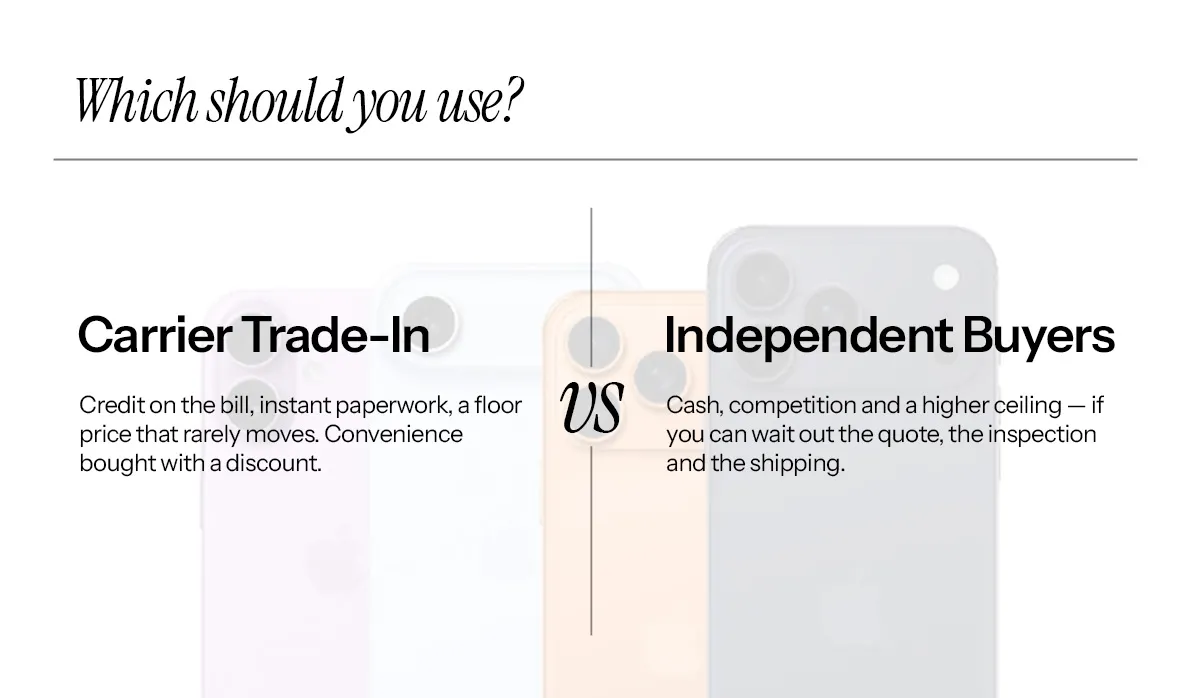
Quick answer: Carriers pay in bill credit, not cash, and that credit typically lands on your next bill or the one after. You also need an eligible post-paid plan, and your device has to turn on and be in good condition. An independent buyer pays cash you can spend anywhere, usually within a day or two, accepts damaged and non-working devices, and does not require you to be a customer. The carrier is usually better when you are upgrading with them anyway, and a bonus credit offer is running.
If you are upgrading your phone, your carrier will offer to take the old one. It is the easiest option to find, because it appears at checkout. That does not automatically make it the best one.
Here is how the two routes actually differ.
How carrier trade-in works
All three major Australian carriers run trade-in programs, and all three operate on the same basic model: you get a quote online, post the device to an assessment partner, and the value comes back as credit on your account rather than money in your bank.
Telstra
Telstra's program is powered by Assurant, which handles the final inspection. You get a rough figure from the Trade-In Quick Estimator, request a trade-in, then receive a final value once the device has been assessed.
The eligibility requirements are specific. You need an eligible post-paid mobile plan, and the device needs to be in good condition and turn on. The program is also not available to customers with a ten-digit account number or those on Upgrade and Protect.
On timing, Telstra states that once your device is received, credit is applied to your account by your next bill or the one after. Full conditions are set out in Telstra's current trade-in terms.
Optus
Optus accepts trade-ins online, over the phone, or in store, which is more flexible than Telstra's online-only process. Value is applied as credit toward your bill or toward an upgraded device, and credit generally appears within one to two billing cycles.
Optus also runs Upgrade and Protect, which is a different product. That is an annual upgrade pathway on an eligible device payment plan, and if you want to keep your existing device you have to pay out the remaining balance.
Vodafone
Vodafone runs a simpler trade-in offer covering phones, tablets and smartwatches, with the value applied to future bills. It does not currently have an early-upgrade programme equivalent to Telstra's or Optus's.
Terms across all three change regularly, especially around new handset launches, so check the current conditions on the carrier's own page before committing.
The five differences that matter
1. You get credit, not cash
This is the single biggest difference, and it is easy to skip past.
Carrier trade-in value is applied to your account. It reduces what you owe that carrier. It is not money you can spend on rent, or on a device from somewhere else, or on anything at all outside that relationship.
If you were going to pay that bill regardless, the distinction is academic. If you are leaving the carrier, switching plans, or would rather have the cash, it matters a great deal.
2. Timing
Telstra applies credit by your next bill or the one after. Optus is broadly similar at one to two billing cycles. In practice that can mean waiting up to two months from the day your device arrives before you see any value.
An independent buyer pays after assessment rather than on a billing cycle. At Phonebot, payment is processed within 24 hours of your device being verified, by bank transfer, PayPal or in-store cash.
3. You have to be a customer
Carrier programs require an eligible post-paid service. Telstra's excludes certain account types outright, including customers on Upgrade and Protect.
If you are on prepaid, on an MVNO, between plans, or simply not a customer of that carrier, the option is not available to you at all.
4. The device has to work
This is where the two routes diverge most sharply.
Telstra's stated requirement is a device in good condition that turns on. Carrier programs generally accept a select list of models from a handful of manufacturers, in working order.
Independent buyers assess damaged devices rather than rejecting them. A cracked screen, a failed camera, a degraded battery or a phone that will not power on all still hold value, quoted at a reduced figure. We have covered how that assessment works in trading in a phone with a cracked screen.
If your device is damaged, the carrier route is often closed before you start.
5. Device range
Carrier programs publish eligible model lists, typically covering recent Apple, Samsung, Google and a few other brands. Older handsets and less common brands frequently fall outside them.
Independent buyers generally quote on a wider range, including devices several generations old.
Side by side
| Carrier trade-in | Independent buyer | |
|---|---|---|
| Payout form | Credit on your account | Cash, bank transfer, PayPal or store credit |
| Timing | Next bill or the one after | Within 24 hours of verification |
| Eligibility | Eligible post-paid plan required | Open to anyone |
| Device condition | Must be working and in good condition | Damaged and non-working accepted at reduced value |
| Device range | Select models, select brands | Broader range including older models |
| Where the value can be spent | With that carrier only | Anywhere |
| Bonus promotions | Often available at launch periods | Store credit uplift available |
When the carrier is genuinely the better option
There are real cases where it is, and they are worth being honest about.
You are upgrading with that carrier anyway. If you are buying your next phone from Telstra or Optus and staying on their network, bill credit is functionally the same as a discount. The cash-versus-credit distinction stops mattering.
There is a bonus credit offer running. This is the strongest argument. Carriers regularly attach launch promotions to trade-ins, adding several hundred dollars of bonus credit on top of the device's assessed value when you buy a specific new handset. Those offers can exceed what the device is worth on the open market, sometimes considerably. If one is running on the phone you were going to buy regardless, take it.
You want it handled in one transaction. Trading in at the point of purchase means one process, one conversation, no separate shipping.
Telstra will consider a better quote. Telstra has run offers where, if you can show an approved quote for the same model in the same condition at a higher value, the difference is paid to you. Worth getting a comparison quote before you accept.
When an independent buyer makes more sense
You want cash. Money in your account rather than a reduction on a bill you may not want to keep paying.
Your device is damaged or not working. The carrier route is usually unavailable. An independent buyer quotes it at a reduced value rather than turning it away.
You are not staying with that carrier. Bill credit with a provider you are leaving is worth very little to you.
You are not on an eligible plan. Prepaid, MVNO and non-customers are excluded from carrier programs.
You want the money quickly. Days rather than billing cycles.
You are buying a refurbished replacement. Store credit toward a refurbished device stretches further than cash, and it is a straightforward upgrade path.
Worth getting a second quote before you accept
Free postage, payment within 24 hours of verification, damaged devices still quoted, and a free return if you decline the offer. No account or plan required.
What to do before you decide
- Get the carrier's quote through their estimator, and note whether a bonus credit offer applies to the handset you want.
- Get an independent quote for the same device in the same condition.
- Compare like with like. A carrier figure including a launch bonus is not the same as a straight device valuation.
- Ask yourself where the value goes. If you are staying with that carrier and buying from them, credit is as good as cash. If not, it is not.
- Check the timing against when you actually need the money.
Whichever route you take, prepare the device properly first. Sign out of your accounts, turn off Find My or Factory Reset Protection, and factory reset it. Our guide to preparing your iPhone for trade-in covers each step, and what happens to your phone afterwards explains what the assessment process involves.
Bottom line
Carrier trade-in is convenient, and when a launch bonus is attached to a phone you were buying anyway, it is often the best value available. Outside that situation, you are accepting credit instead of cash, a wait of up to two billing cycles, and a requirement that your device works and you hold an eligible plan.
Get both quotes. It takes a few minutes, and the gap is frequently larger than people expect in either direction.
If you are weighing a third option, we have also compared trade-in against selling privately, and set out the full process in our iPhone trade-in guide.
Posted by Liam Harris


Liam Harris
Liam Harris is a tech writer at Phonebot, covering refurbished phones, tablets and wearables since 2022. His buying guides and model comparisons draw on live Australian market pricing and Phonebot's experience rehoming over one million devices.


 Google
 Apple
Apple Facebook